


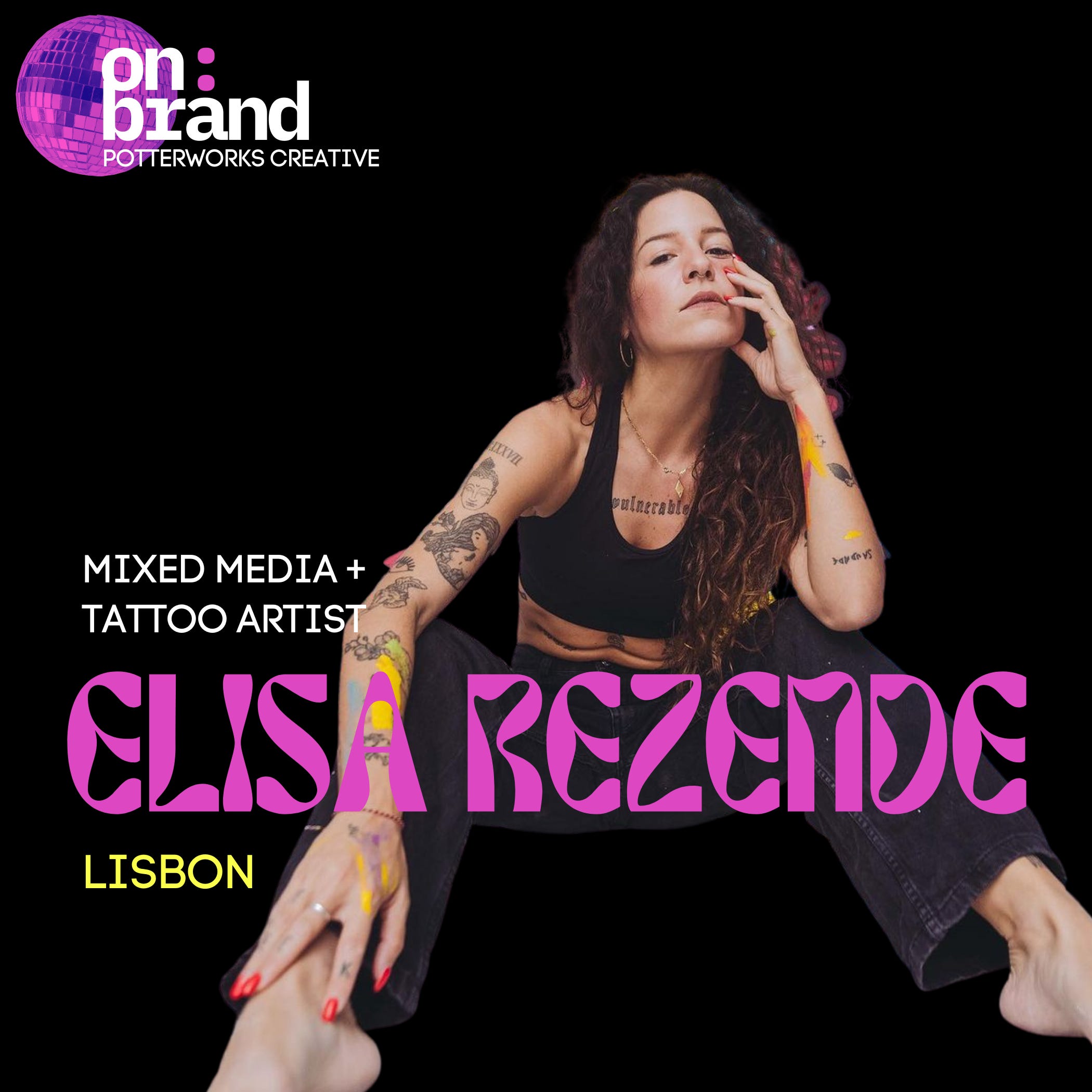
“I've come to terms with what I'm interested in life is rawness. It's the humanness in people. I'm not interested in perfection and keeping up masks and all that, even though we have to use them for societal purposes. But, you know, I like the rawness.”
Potterworks Creative Founder, Kristyn Potter: Okay, so this is on:brand, a blog series about brands, identity, expression and entrepreneurship. It's not a podcast, so I won't say ‘episode one’. Let’s go with ‘interview one’.
Elisa Rezende: Ooh, one. I'm so glad to be one. Number one.
Kristyn Potter: So, this is going to be super easy breezy. And let's hope it records. That's always a journalist’s greatest fear - that you get the best interview and the technology somehow fails. But anyway, I don't think it's going to. I'm not going to bump into anything. I'm super focused here. I'm not even going to look in that direction.
So, this is called on:brand discourse. Let's start with your introductions. Your name, your preferred pronouns, etc.
Elisa Rezende: I'm Elisa Rezende. And I'm she/her.
Kristyn Potter: We'll start with an icebreaker. What's a brand—a person, a place, or a thing that you admire?
Elisa Rezende: First thing that comes to mind, I would say it's a person who's already passed. Frida. I'm going to say Frida Kahlo. Because she was a woman, and that's reason enough. And also because she was a badass. She was a feminist. She was advocating for herself in the midst of so much controversy and so much difficulty. And she was one hell of an artist. She would not have a problem painting her feelings how she wants to. And she's an inspiration. Yeah. And this realism that she has around her makes me so inspired.
Kristyn Potter: So, how did you get started with your craft? What would you say your craft or your claim to fame is?
Elisa Rezende: I would say that I'm an artist. And by that, I mean all of the things: I am not only a tattoo artist, I'm not only a plastic artist, visual artist, or digital illustrator; I'm also a consumer of concepts and a thinker of new ways of doing things and all that.
And I think this because when I look back, I see that I've always been like this ... I remember me as a child, loving to draw, loving to write, going to acting lessons, and so on and so forth. And just loving it, loving it so much, just the freedom to create whatever and to be whatever.
I've always been [an artist] but because of our society and what we are taught, I just believed that I was not a genius enough to be able to make this as a living. And so I went to study advertising and marketing.
The triggering point was my mom passing away, that made me think about life a lot, like, what is the point of what I'm doing? And am I happy enough? Because actually, time goes by really fast. And so I should be doing something that really matters to me.
So at that point, I decided to just quit my job and go traveling to Southeast Asia for four months. I took a notebook with me and just started doodling out of the blue, really, because I had a lot of time to kill. And that's how I started ... and just fell in love with it.
Kristyn Potter: Did you see any recurring things when you were doodling?
Elisa Rezende: I've experimented with a lot because, obviously, I had already been consuming a lot of art, especially on Instagram and Pinterest. So I was trying out and kind of like imitating a lot of stuff that I was seeing. And so I had to try out a few things to be able to say, "Oh, no, I'm more like this style," you know? But there are a few elements that I would do back then, and I still do now. Honestly, I'm not able to let them go; it's part of my art.
The eyes are a thing that represents me, the raindrops/tears. Then there's a lot of words. So, what I do naturally is that I pick up words or expressions, and I make them mine. That's what I did with the 'let it burn, babe,' which I cannot let go of. And before that, there was the 'forever vulnerable tribe' and the 'chaotic and intense.' There are a lot of stars and, obviously, the lettering, which I developed a little bit later in that process. There's the heart. So, if you ask me why I do them and why I keep on doing them, I don't know. It's got to have something to do with my unconscious mind. But you know ...
“I've come to terms with what I'm interested in life is rawness. It's the humanness in people. I'm not interested in perfection and keeping up masks and all that, even though we have to use them for societal purposes. But, you know, I like the rawness.”
I guess eyes are the representation of that. And in the heart, obviously, is the feelings and prioritizing your feelings over your thinking, which I'm not very good at doing, if I'm being honest. And the rain and the tears, I will say that it's my sadness. I am such a bubbly person, but I am also sad. I like it when people are true on that topic: we all have a sadness within, and it's good to acknowledge it and use it for our good.
Kristyn Potter: Talking to you is amazing. I'm not even looking at my questions anymore. So I want to pivot into branding a bit, and we'll go into your business, which is honestly ... I'm still in shock sitting here. It’s GORGEOUS.
Elisa Rezende: I feel like as much as I want to be raw and myself and want my art to sell, I also know, maybe because of my context in advertising and marketing, I know that it has to make sense for other people so that they can buy it and consume it.
And so, I am working with a social media team so that everything that I put out in the world makes sense, has got my colors. I'm trying not to be too strict about it, but obviously trying to have my own colors and my lettering and my own way of talking. I try to be as close as I can to what I feel and want to put out in the world, having the knowledge that I have to have a strategy behind it.
I just worked at Boom [festival], and they wanted me to come up with a few installations. And obviously the Boom identity is very much psychedelics and all of that vibe. And I was like, all right, I really want to get into this. I don't want to lose my identity here because then what's the point? How do I mix the two of them together? So, I had a look at what Boom has been doing, what the logo was, and what are my non-negotiables. And so I put the heart, and I put the eyes, and I put the rain... you know, so how do I mix the two of them?
I got a few messages from people saying, oh, I had a look at your stuff, not knowing that they were yours. And I thought about you. So, that's what I wanted. I wanted for those for those pieces to blend in the atmosphere, but also so that people could look at them and be like, oh, that's Elisa, you know. It kind of blended in, and I'm happy with the outcome.
Kristyn Potter: I run into this a lot because, I'm in a space where it's healthcare, science, and really smart people. But then my other half of me, you know, is like tattoos and music and mosh pits and all that. And it is, I think, sometimes difficult to blend in or kind of find the space where you are still yourself in a space that isn't fully you. But I do think that it is possible. You just want to make sure it's appropriate without losing yourself. So it's a constant battle.
Elisa Rezende: Exactly. And just remembering here about my agency times, a brand has got to have the ability to stretch, right? And so here (*she motions*) is my comfort zone. This is where I belong. But, if I go somewhere, which is very different from my atmosphere, then how do I behave there? [Boom] was a good exercise of stretching.
Kristyn Potter: So how did you end up here, in this studio in Santos?
Elisa Rezende: One of my favorite artists of all time, she announced that she was going to deliver this three-month mentorship for people who were already making art but wanted to become full-time artists. And I was like, that sounds like me. And so I was like, I'm not doing anything. I don't really have a plan because I'm not going back to advertising. So why not?
So that's what was the realization, the transformation revolution for me. After that, I considered tattooing. I went on to buy my first tattoo machine on Amazon, not knowing anything about it and all that. It was a progress. I first started off in my place, in my bedroom; people were getting tattooed on top of my bed and all that. And, then, I moved up. So I have this like storage room up in my apartment. There was no toilet. Obviously, people had to go to my place to go to the toilet. I tattooed there for a year until last year last summer. I was having brunch just here with my boyfriend (at the time), and we were walking around after brunch and he was like, "You know what, this is the perfect place for you to have a studio," and I was like, "Yeah, wouldn't it? You know, what a dream."
And then, a few months later, I went online just out of curiosity and checked for commercial places in Lisbon, thinking they should be very expensive. And you know, it's a crazy idea. And the first place that comes up is this place. And I'm like, no fucking way. Sorry. No way. No way. I'm the first person to call, and I'm the first person to visit. And I bring my dad because obviously, he knows a bit better than me. And I'm like, so dad, what do you think? And he was like, go for it. And so the very same day, I called them and said, I'm going to keep it.
Kristyn Potter: During that time, what did you do for motivation?
Elisa Rezende: I would listen to a lot of podcasts, for instance, Marie Forleo, I love, and Doyle and Brazilian people too, like Tati Bernardi. A lot of ... women doing things, being independent, fierce, going after their dreams. And so that would give me a lot of strength.
Kristyn Potter: How do you separate your personal identity from your brand? And how do you leverage it?
Elisa Rezende: That's a really good question. Because if we're talking about art, this is me, there's no separation. Whatever I do, whatever I put on whatever surface it is, it's me. And whenever someone comes for a tattoo, it's me. So it's really difficult. I'm not gonna lie; I do struggle with it. I still have a lot of work to do in terms of just logging off and resting. Because the point that I am now is, even if I go out with friends, or if I'm having dinner with you, or if I'm on my couch just watching a show, I'm going to be thinking about work, I'm going to be replying DMs, and because I have so much energy, it's really difficult for me to really separate because I really have pleasure in what I do. So it's really difficult to just be like, if you stop, it will become even better.
Kristyn Potter: What trends are you seeing in either the tattoo space or the artist space?
Elisa Rezende: The first thing that came to mind was trash culture, as in trash tattooing, trash art. Before, you would have very precise things and neat things and all that. And now you're seeing people coming as they are and painting as they feel like as if it was an occasion. Like an explosion of adrenaline and everything they have inside them.
Kristyn Potter: People just want, people have things that they want to say. Finally, my last question. This is an easy one because there's no wrong answer. What is your definition of branding?
Elisa Rezende: Is it too advertising of me if I say that we are all brands? Because we're all branding for something. I just think that some of us are aware of it and know that we can gain stuff with it or not.
Thanks to Elisa for this lovely, first interview. And thanks to everyone who made it to the end of this article.
Know someone making a splash in their space? We want to pick their brain. Send us an email at hello@potterworkscreative.com.